You’ve stood at the mouth of a cave before.
Felt that cold breath rise up from the dark.
Wondered how something so huge and detailed could exist under solid rock.
Have you ever wondered how such a vast, detailed space could form beneath our feet?
I have. And I’ve spent years watching water carve stone, tracking how tiny cracks become massive chambers.
This isn’t guesswork. It’s basic geology. Basic hydrology.
Real processes we can see, measure, and trace step by step.
How Lerakuty Cave Formed is not a mystery. It’s a sequence. A slow, constant story written in limestone and time.
I’ll walk you through each stage. No jargon, no fluff.
Just what happened, when it happened, and why it had to happen that way.
You’ll understand it by the end. Not just memorize it.
How Lerakuty Cave Formed: A Sea, Some Shells, and Time
I stood in Lerakuty Cave last spring. Felt the damp air. Touched the cold limestone wall.
And thought: This used to be ocean floor.
It was a shallow sea. Warm. Teeming.
Millions of years ago. We’re talking Carboniferous period, roughly 360 to 300 million years back.
That’s not just old. That’s before dinosaurs. Before trees had bark like we know it.
The bedrock here? Almost all limestone. Calcium carbonate.
Built from the piled-up shells and skeletons of tiny sea creatures. Not magic. Just death, pressure, and time.
Limestone dissolves in weak acid. Like rainwater mixed with carbon dioxide. It also cracks easily.
Has natural fractures. Joints. Weak spots.
That’s why caves form here and not in granite or shale.
Granite doesn’t budge. Limestone surrenders.
Read more about how water found those cracks and widened them over millennia.
I’ve walked other caves where the rock is tight and stubborn. No flow. No hollows.
Lerakuty isn’t like that.
Its walls breathe. Water still moves behind them.
That’s the limestone doing its slow, quiet work.
You don’t need fancy gear to see it. Just look up at the ceiling. See those smooth curves?
That’s dissolution. That’s chemistry wearing stone down.
Some people call it erosion. I call it patience.
How Lerakuty Cave Formed isn’t a mystery. It’s a sequence: sea → shells → pressure → rock → water → time → cave.
No drama. No explosion. Just water, waiting.
And us, finally showing up to notice.
The Catalyst: Water’s Slow, Constant Hand
Rain hits the air. It grabs carbon dioxide. That makes carbonic acid.
Weak, yes, but sharp enough to work.
I’ve watched this happen in limestone outcrops near Austin. One drop. Then another.
Over centuries.
It’s not magic. It’s chemistry you can taste (like) biting into a lemon wedge and feeling your teeth prickle.
Carbonic acid meets calcium carbonate in the rock. They react. The rock dissolves.
Not all at once. Not even fast.
Think of sugar in coffee. You stir. It vanishes.
But here? No stirring. No heat.
Just time. Thousands of years of time.
You’re probably wondering: How does a drop of water carve a cave?
It doesn’t. Not alone.
But it finds a hairline crack. Then another. Then follows the path of least resistance (down,) sideways, deeper.
That’s how Lerakuty Cave Formed.
No explosion. No collapse. Just water insisting, drop after drop, year after year.
I once traced a single fissure for half a mile. It widened just enough for my fingers. That same seam now holds a vaulted chamber 80 feet tall.
The limestone doesn’t fight back. It just yields. Slowly, evenly, completely.
People call it erosion. I call it persistence with a PhD in patience.
You think your deadlines are slow? Try waiting for a stalactite to grow one inch.
That first drop started it. So did the million after.
Don’t underestimate quiet water. It reshapes continents.
And it never asks permission.
Fissures Don’t Stay Small (They) Eat
I stood in the entrance of Lerakuty cave last October. Cold air rushed out like it had been waiting. You feel it (that) slow, deep grind of geology happening right under your boots.
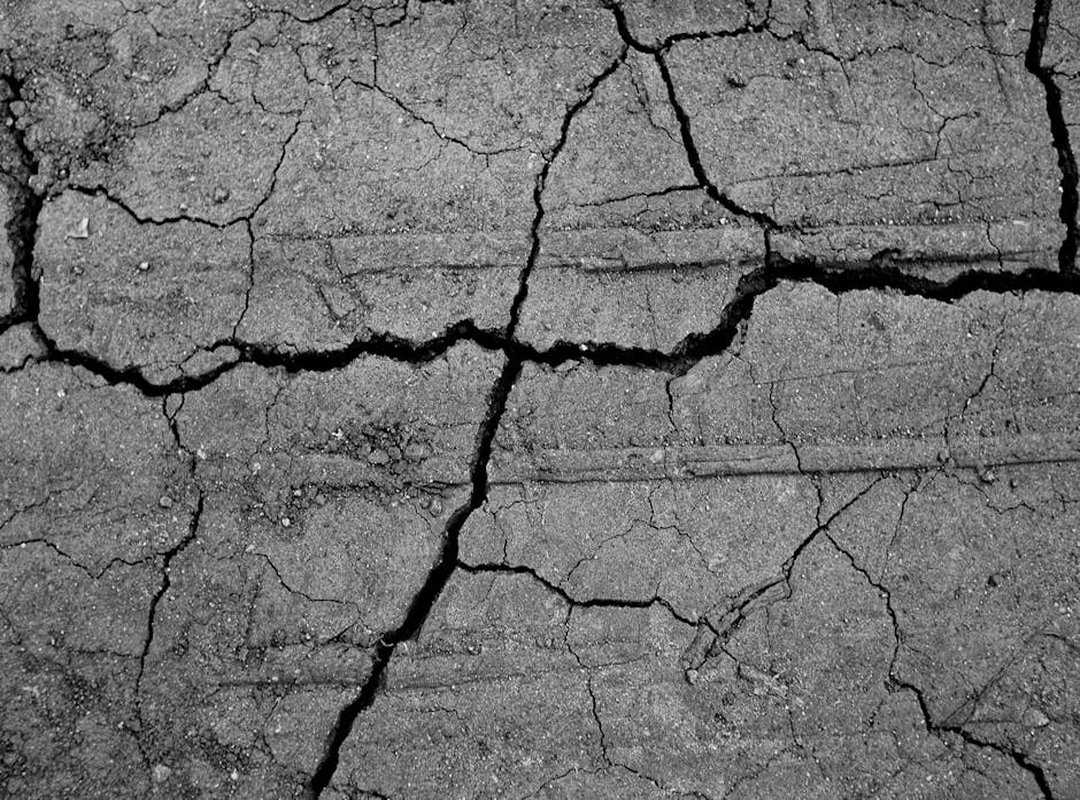
Water finds a hairline crack in limestone. Not dramatic. Just a trickle.
But it’s acidic. It dissolves the rock molecule by molecule.
That’s how it starts.
Then more water joins. Then more. The flow picks up speed.
And now it’s not just chemistry. It’s physics. Mechanical erosion kicks in.
Sand. Gravel. Pebbles bouncing along the floor.
They scrape. They scour. They wear down walls like sandpaper on old wood.
I watched a guide point to a groove in the wall (smooth,) polished, six feet high. “That wasn’t made by water alone,” he said. “That was made by grit moving fast.”
The network grows. One fissure feeds another. A side passage siphons off flow.
Then that one captures more. It’s a feedback loop (more) water means more erosion means bigger passages means even more water.
The water table is the boss here. When it drops, old tunnels go dry. New ones form lower down.
That’s why Lerakuty cave has stacked levels (some) damp and active, others silent and dusty.
You see those grand rooms? They’re not accidents. They’re the result of decades.
Centuries — of water insisting.
How Lerakuty Cave Formed isn’t magic. It’s persistence. Chemistry plus motion plus time.
I walked through the Grand Passage and thought: this used to be a crack you could barely fit a fingernail into.
Lerakuty cave shows all of it. The raw edges, the smoothed curves, the places where water still drips.
Don’t rush through it. Stop. Touch the wall.
Feel the grain.
Speleothems: When the Cave Starts to Bloom
I used to think caves were just holes in the ground.
Then I saw Lerakuty’s ceiling drip for the first time.
That water isn’t just falling. It’s loaded (saturated) with dissolved calcite from limestone above. It’s heavy with memory.
With chemistry. With time.
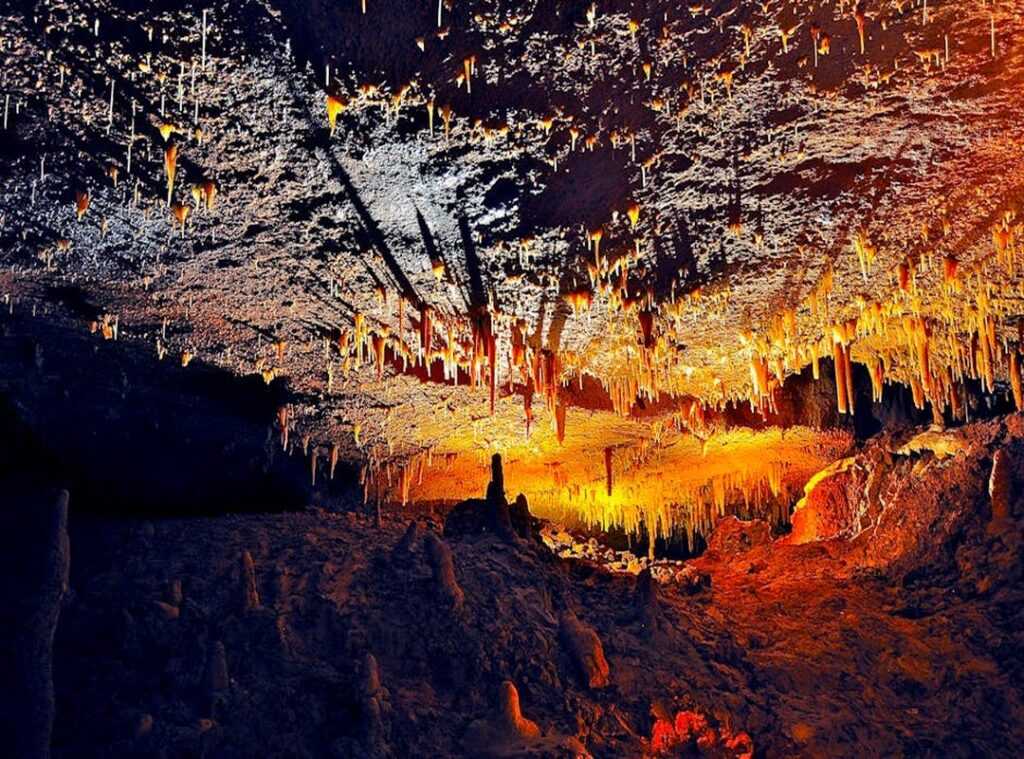
Each drop hangs, breathes out a little carbon dioxide, and leaves behind a speck of calcite. That’s how stalactites grow. Not fast.
Not loud. Just one drop at a time.
The same drop hits the floor. Spreads. Evaporates.
Drops more calcite. Stalagmites rise up to meet them.
Sometimes they touch. That’s when you get a column. Solid.
Silent. Unhurried.
Flowstone? That’s when water runs down a wall instead of dripping. It coats surfaces like slow, cold frosting.
This isn’t erosion anymore. This is deposition. This is decoration.
This is geology showing off.
You want to understand How Lerakuty Cave Formed? Start with the water. Not where it came from, but what it carried and where it left it.
I tracked that water for months. Saw how its rhythm shaped every curve.
If you want the full story on the movement, the pauses, the chemistry (read) Water in the lerakuty cave. It’s not theory. It’s field notes.
A Cave That Took Forever to Make
I stood in Lerakuty Cave and felt small. Not because it’s big (but) because it’s old.
How Lerakuty Cave Formed isn’t magic. It’s rock. Water.
Time. Millions of years of slow, quiet work.
You wanted to know how something so detailed could come from nothing but limestone and rain. I get it. It feels impossible (until) you see the layers.
Until you touch the flowstone. Until you realize time isn’t abstract. It’s dripping.
It’s dissolving. It’s building.
Caves aren’t dead spaces. They’re still breathing. Still growing.
Still changing.
So next time you visit one? Don’t just take a photo. Pause.
Look at the ceiling. Ask yourself: what’s happening right now that I can’t see?
Go underground. Watch geology in motion.
You’ll never look at a cave the same way again.
 Lead Forest Survival Specialist & Outdoor Educator
Timothy Peters is Whisper Forest Ways’ resident expert on wilderness survival and all things related to thriving in the outdoors. With a background in environmental sciences and over a decade of hands-on survival training, Timothy combines scientific knowledge with practical experience to teach readers essential survival skills, such as shelter building, fire making, and foraging. His approach emphasizes respect for the natural world and sustainability, ensuring that all of his methods encourage low-impact interaction with the environment. Whether you’re new to outdoor adventures or a seasoned explorer, Timothy’s detailed guides and insights provide invaluable knowledge for safely and confidently navigating the wild.
Lead Forest Survival Specialist & Outdoor Educator
Timothy Peters is Whisper Forest Ways’ resident expert on wilderness survival and all things related to thriving in the outdoors. With a background in environmental sciences and over a decade of hands-on survival training, Timothy combines scientific knowledge with practical experience to teach readers essential survival skills, such as shelter building, fire making, and foraging. His approach emphasizes respect for the natural world and sustainability, ensuring that all of his methods encourage low-impact interaction with the environment. Whether you’re new to outdoor adventures or a seasoned explorer, Timothy’s detailed guides and insights provide invaluable knowledge for safely and confidently navigating the wild.